Monday, February 23, 2015

Buffy vs. Dracula:Representation of Gender

 In this episode of Buffy vs. Dracula, it opens up with Buffy in bed and she wakes up to slay a vampire in the cemetery. This kind of foreshadows that she will soon meet Dracula in a cemetery, which she does not too soon after. The characteristics of Dracula were similar to those in the book, his skin complexion was pale, although he did not have red lips, they were pale in Buffy vs. Dracula. He also had long hair, black, about shoulder length. At first she had not even recognized him or knew who he was. But once he revealed himself as Dracula, she tried to kill him like she would any other vampire.


There were a few similarities from this episode and from Bram Stoker's Dracula. One being that he was carried in a large wooden box filled with dirt. We see this when the workers are unloading the box at the castle and Dracula slashes the workers throat. Another similarity is when Dracula comes through Buffy's room as fog, just like in the book when he enters the room as fog to get to Mina. Dracula longs for Buffy just as he longed for Mina's affection.


Gender is portrayed throughout this episode frequently. Usually when faced with adversity, the female character/ damsel in distress would run and be screaming her head off trying to fight for her life. In this case, Buffy does not run from Dracula, but almost like she embraces him. Kind of like she is toying with him. Dracula cannot just go at her, he wants to have a connection with his victims. He wants them to long for him like he longs for them. At first when they are in the castle towards the end of the episode, he says that she cannot resist him, he exclaims it is because she does not want to. But here she is using her looks and innocence to get him aroused, to make it seem like she is under his spell. Typical for a female gender role, a woman manipulating a man to get what she wants. The stereotype of fighting like a girl also comes into play here. Clearly, Buffy is capable of holding her own and is more than capable of defending herself. Perhaps fighting like a girl is not so bad in this case. Although much cannot be said for Xander who put under Dracula's spell, catering to him. This places him in a feminized role, catering to Dracula.

Dracula: Bram & Brooks

 After watching Dracula: Dead and Loving It, it was apparent howsimilar it is to the novel despite all the satirical comedy. Director Mel Brooks stayed true to Bram Stroker’s story, while making fun of his characters, broadening the story of Dracula to a new audience. The movie itself does not go two minutes without someone tripping, repeating themselves, or pronouncing a word in a funny way (Dr, Seward's “raspberry” was a personal favorite). As opposed to the novel, Dracula’s introduction is far from dark and mysterious. He is first shown in a bright room and immediately slips and falls down a flight of stairs. After collecting himself, he shows a sense of being supernatural when he walks through a large spider web without affecting its shape, but then almost immediately makes you forget it when he takes off and hangs up his comically large wig. This adaptation allows for people who may not be as familiar with the story line of Dracula to easily understand the characters and story in a new and lighthearted way.

There are obvious enforced gender roles throughout the movie that even an untrained eye would be able to notice. Almost all of the costumes worn by women were not only form-fitting, but low cut to show cleavage. Their make-up seemed to be done excessively, and the make-up artist put an emphasis on red lipstick, which is a common trait in the novel relating to sex. Even though all of the characters in the movie make mistakes for the sake of comedy, some that really stick out are ones made by the female characters. When Dracula was hypnotizing Mina and the maid who was guarding her while she slept, they both would do the same command instead of only Mina, frustrating Dracula. By not following the orders correctly, that can be portrayed as the women were so senseless that they could not even do things right when in control of others.

Another point that was made that was similar to the novels was the use of a white dress on a woman. This white dress represents a woman’s purity and it was what Mina was wearing when Dracula took her away to his castle. Mina, showing love for Dracula willingly danced with him, though both of their shadows portrayed something different. Shown on the wall behind the two, their shadows danced more proactively until yelled at by Dracula. Throughout the film Dracula’s shadow seemed to have a mind of its own, allowing the audience to assume that it show’s his true thoughts. This being said, when Mina’s shadow shows “impure” advances towards Dracula’s, it is to be assume that she too loves Dracula and is taking control of her sexuality. 


Another instance in which a female character owns her sexuality is when Renfield is visited by the two women vampires (different from the novel which had three visiting Jonathan). The women entered the room moaning in arousal and seductively leaning on the bed frame.


As Dracula kicked them out, they began floating away while music played. Noticing the sexual exit, Dracula immediately told them to “cut it out!” to which the women slouched down and walked out like normal people. This hilarious take on the two women led me to think that they were in control of how they were perceived by men and could not only control their own sexuality, but use it to their advantage.

In Brook’s adaptation of Dracula, Lucy comes onto Jonathan in the cemetery after being killed by Dracula and placed in a tomb. She uses her breasts to try and put him “under her spell” (again claiming her sexuality as a woman), and right before she succeeds as she is about to bite his neck, Dr. Seward saves him. When Lucy retreats back to her coffin, Seward and Jonathan plan to kill her by hammering a steak into her heart. With every blow, an excessive amount of blood shoots out of Lucy’s body all over Jonathan. This large amount of blood can be compared to when Lucy was first bit in Francis Ford Coppola’s Bram Strocker’s Dracula and blood splattered throughout the room. This imagery can be compared to Lucy losing her virginity or purity after showing any sign of sexual pleasure. In Coppola’s version, when she is aroused by Dracula, and in Brook’s when she comes onto Jonathan.
                     
(Side-by-side: Coppola's and Brook's adaptations)


Overall, the way female characters are portrayed in this film is almost expected. The typical tight dresses and cleavage only emphasize the outdated (even for 1994) ideas that women are limited to their looks. Though in this adaptation, women are not the only ones challenged. One scene that stuck out to me that tested a male role was in the last scene. When Jonathan was trying to save Mina from Dracula and attempted to drive a stake in Dracula’s heart, Dracula took the stake from him and broke it in half. This while seen as comical to the audience, could be interpreted as Dracula taking away Jonathan’s masculinity and defeating him. Dracula then transforms into a bat, which again, Jonathan is unsuccessful in catching and defeating, and is ultimately killed by sunlight at the hand of Renfield. This loss of Jonathan’s masculinity goes unnoticed by him and is quickly reclaimed as he carries Mina home.

In a hilarious adaptation of an otherwise frightening story, Mel Brooks perfects the story of Dracula and it's constant themes. By making his audience laugh, Leslie Nielsen makes Dracula likable, despite his committed crimes. Brooks allows the audience to comprehend the story of Dracula in a new way, while paying homage to Stocker's novel as well as over movie adaptations. Aside from all of the important gender norms portrayed (note the sarcasm), if you take one thing away from watching this movie, it should be to make sure a window is open before transforming into a bat and attempting to fly through it!


Dracula: Dead and Loving it


Dracula, Dead and Loving It is a satirical comedy mocking the novel written by Bram Stoker. Many films portraying Dracula are very similar. They are serious, frightening, and subtly sexual. Mel Brooks adaption creates a light-hearted atmosphere while also following the story. 

The film begins with Thomas Renfield, rather than Jonathan Harker. After arriving at Dracula’s castle, Renfield can be seen sleeping peacefully in bed by himself. He is then joined by two women with extremely protruding cleavage. They dramatically and unashamedly rub their bodies against his as he rejects their advances. These sequences differed from the book in more ways than one. Dracula did not greet Renfield at the door and warmly welcome him in. Renfield was not offered accommodations such as dinner and a cigar. Also, there were two sisters in the film rather than three. I believe these differences show Dracula to be a more selfish, absent minded being; only giving attention to those which he may feed from. 


Through the film, the appearance of women’s cleavage was seen more than Dracula himself. Every woman looked as if her breasts were pushed up towards her chin. This was done ironically to emphasize the symbolism of blatant female sexuality.

I noticed quite a few times in the middle of the film when Lucy and Mina can be seen wearing a white night gown, symbolizing their purity and innocence. Lucy is the first of Dracula’s victims. However, in this adaptation, she opens the window to her bedroom and stands in front of it while removing her robe. She reveals her neck and cleavage, as if to purposefully tempt Dracula. 

After Lucy and Mina are bitten, they became promiscuous, each trying to seduce Jonathan. With failed attempts, their condition is found out by Dr. Van Helsing who repels them with a silver cross. Subsequently, after this encounter, Mina begins to only wear black gowns. 


Color symbolism is a major part of this film. Jonathan Harker, Dr. Seward, and Dr. Van Helsing wear similar black suits. Yet, Dracula is the only character that is shown wearing red. His cape could be viewed as a way to shield himself. It is colored black on the outside to indicate his surface-level similarity to those around him, but red on the inside to portray his eternal lust for blood. 


The treatment of gender was extremely obvious. Although the actors purposefully used the art of humor to get their point across, gender stereotypes were heightened. Women were often 
represented as forgetful, soft spoken, and obedient. A scene in the film illustrates Dracula puts Mina in a trance in order to lead her out of the house. He commands her to walk through the door, prompting her to walk into the closet. The maid arrives, also falling under the trance, causing both women to become completely absent minded and unable to follow direction.

However, the men were seen as problem solvers. When Lucy had to face the true death, Jonathan drove the wooden steak through her heart. When there was a medical problem, Van Helsing was not far behind with his silver cross. Lastly, Dr. Seward gave the same answer to every difficulty which he faced: “Give them an enema”. 

In conclusion, Dracula: Dead and Loving It created a new approach to an old story. The majority of the film followed closely to the novel, yet put a humorous spin on the situations. Men and women were portrayed as stereotypes in order to force the audience to think deeply of the different ways each gender is treated. 

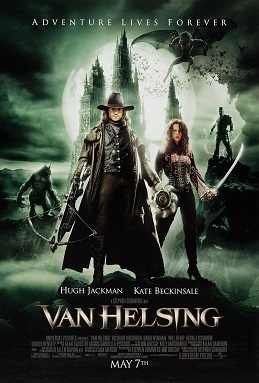
"That's not all I can do to your skin..." Van Helsing vs. Dracula 2004


In most movies, we always see the hero of the story portrayed as the strong, handsome, masculine male who swoops in to save the day. He always finds a way to save the people and win over the damsel in distress. All of this is prevalent in Van Helsing. Van Helsing, played by Hugh Jackman, is the rugged hero of this story who has to capture and kill even beings because he is considered to be doing God's work from the monks. In the beginning of the movie Van Helsing is told he is to travel to Transylvania to kill Dracula. That is where we meet the Valerious family, specifically Anna and her brother Velkan. Velkan fails to kill Dracula's werewolf and gets bitten, so now Anna is left on her own with Van Helsing to save everyone from Dracula and to send her family to heaven because her father made a promise to God that until his family kills Dracula, he shall stay in Purgatory. 


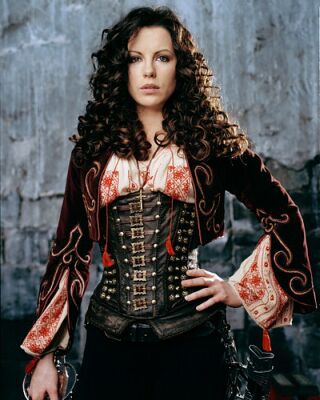
From the moment we first meet Anna in the movie, played by Kate Beckinsale, we already know that she is the stereotypical beautiful character in the story. She fights in high leather boots and wears tight revealing clothing. Although she is an extremely powerful character, and she can clearly fight very well, one of the first things we see in her first scene is her brother telling her to stay back and not to fight. Already we know that the men in the story are thinking of her as just a weak woman, even though she is extremely powerful. When she first meets Van Helsing, in one of the fight scenes she lands on him with her legs spread sitting close to his face. That is just another example of how even though this is a strong woman who is very independent, she is extremely sexualized in the movie. They are shown rolling around on the ground together, and Van Helsing is another man telling her to stay back and trying to keep her safe.


Anna is not the only sexualized character within the movie. Just like in Bram Stoker's Dracula, Dracula has three female vampires almost as his "mistresses" doing his every command. When we first see them they are flying around like bats, but when they transform into their "human" looking form, we see that they are very beautiful women dressed in barely there clothing with their breasts popping out of their dresses. Here again is another example of the female needing to be beautiful, or something to look at. We see a scene with them where Dracula punishes them for loosing one of their own, but tells them to come to him where he kisses them and brings them into his chamber to make his "children". He says he is incapable of love, so he keeps them around to kill for him and mate with him. 


At the point in the movie where Anna gets captured by Dracula and they are dancing together at the ball, Anna is only awakened with a kiss. She fights him but he tells her that she is going to be his bride because she is "very beautiful". He also tells her they are going to have children and stay together forever. When she tells him he makes her skin crawl, he threatens her back saying "That's not all I can do to your skin," basically saying if you do not do as I demand I will kill you. Here we see a representation of typical gender roles, the male telling the female what to do. While this is going on, Van Helsing is being the hero he is portrayed to be literally swooping down to save Anna. Although Anna is supposed to be very powerful, she needs to be put in compromising positions because she is woman who always needs saving.


Throughout the entire movie, all these female characters, who are continuously fighting, never look like they've been through battle. They all are made up to look completely perfect even after the vicious fighting that goes on. However, the men in the story always look beaten up after they have been fighting because that is what realistically will happen. 

Although Anna and the three female vampires are portrayed as strong characters, this movie does nothing to break stereotypical gender roles. However, this does not mean that this was not an extremely fun movie to watch. It was very interesting to watch this movie through the eyes of gender and very eye opening to see how movies and books in general portray women and men so differently. 


"Buffy vs. Dracula"... How the female gender is represented.


Erynn McLoughlin
2/23/15
                Buffy the Vampire Slayer (2000, Episode 5.1) “Buffy vs Dracula” adapted the original Dracula in several different ways. Buffy represents Mina in the television series but this episode starts off not like one would expect after reading the novel. Lucy was the one in the book that would go out into the night and sleepwalk and then return home to a worried Mina at times. At the beginning of this episode it is Buffy running through the graveyard which the initial reactions of viewers would see that as a representation of Lucy’s adventures during the night. Buffy fights with a vampire and by stabbing a wooden stake through his heart she kills him and he turns to dust. Buffy is a vampire slayer if one didn’t already know and that’s why she was running through the graveyard and fighting a vampire. There are several other ways this television series adapts the story of Dracula.
               Dracula is known to be able to travel across the sea through large boxes filled of dirt. This is clearly shown in the episode when the men were unloading a huge box from the back of their truck and once it fell and hit the ground, dirt started pouring out of it. After the dirt poured out a masculine figure arose from the box and killed one of the men instantly. The original story is adapted by still having Dracula’s appearance the same with his sharp teeth and finger nails and his pale skin. Dracula also has an accent and is dressed in a long dark red and black cape. Dracula enters Buffy’s room through a white fog and then after hypnotizing her, he was able to bite her neck. Just like in the original Dracula the men have Buffy (Mina in the novel) stay home while they go out and look for Dracula. Overall, the main purpose of Dracula coming to them was because of his urge to have Buffy just like the main purpose in the novel was to have Mina.
               Gender in this television episode was seen in several different ways after analyzing it. At first women in this movie can be seen as fierce or strong. It starts off by showing Buffy running through the grave and fighting, which ends up killing, a male vampire. When Dracula met Buffy for the first time face-to-face his words could have persuaded other female characters to act a certain way but Buffy was strong to her beliefs and stood up to him. At the very end of the episode it shows Buffy resisting Dracula’s hypnotizing mind which tried to have Buffy drink his blood from his wrist. Buffy was able to push him away which lead into a fight. No matter how hard it was Buffy never gave up and continued to fight the strong male character until she stabbed him with the wooden stake.

               While the television episode started to unfold the female characters seemed to change a little bit and turned into more weakened ones. It started off by Buffy having a male character watch over her and that shows that women are weaker and need a sense of protection by a male dominant figure. Then when Dracula was seen by Buffy and Willow he was seen as a sexy figure with dark, penetrating eyes. Dracula had a hypnosis placed on Buffy which made her weak and do whatever he told her to do. Dracula told her to move her hair off her neck so she did and then he was able to bite her without any complications because of the trance she was in. Overall, women’s role in this television episode, even though started off as strong, independent characters definitely changed and were mostly seen as weakened, dependent characters.
Buffy  Vs. Dracula: Episode 5.1


While watching Buffy Vs Dracula, I was easily able to compare this video to the novel our class read. Buffy became Mina, Xander became Renfield, Giles became Van Helsing, Riley as Johnathan, etc. While reading the novel, it was hard for me to understand why Dracula came off “so appealing to Mina (Buffy), but watching a video to follow up the information in the text, it is clear how Dracula’s seduction is able to hypnotize Buffy in this episode. Dracula and Buffy’s first encounter is in the middle of the night in the middle of a gloomy cemetery. She attacks him without much conversation beforehand, then strangely enough, returns to her bed and falls back asleep. Meeting him for the second time, she then finds out that he has been “searching the world for her”. Similar to the novel, Dracula in “fog form” enters her room through her window and suddenly appears. Without much hesitation, Buffy moves her hair from her neck and slowly but surely, allows him to penetrate her neck with his teeth. Her reaction to this bite reminded me much of a women in an orgasmic state. She went completely numb as he took full control over her.


Xander, who plays “Renfield”, is walking home alone and comes face to face with the Count. At first he is frightened to be alone with Dracula, but after being hypnotized, he starts referring to him as “Master” and "The Dark Knight", agreeing to whatever Dracula asks of him. In return for this favor, Dracula tells Xander he will forever be immortal. I realized that Xander took on the role of Renfield when he grabbed a spider off the leaves of a bush and quickly ate it while no one was looking. 


Gender roles were obviously shown throughout this film. When the group wouldn't allow Buffy to do anything on her own because she was too weak to handle Dracula, it proved how much more valued men were because they were "stronger". In Buffy Vs Dracula, I think Buffy was given more credit for slaying Dracula compared to the credit Mina got in the novel. Buffy ends as the hero of the group, while Mina was just one of the few who ended as a hero in the novel. Mina and Buffy should be the heroes at the end because they were victims of Dracula, and still managed to take him down once and for all. In the Buffy Vs Dracula episode, it was a more modernized version of Stoker's novel Dracula, so it helped me to understand the important parts of this story line more clearly because I was seeing these events visually instead of reading a text.


"Children of the night, shut up!"


Love at First Bite directed by Stan Dragoti was definitely the funniest, if not the cheesiest, vampire film I have ever seen in my life. Of course, just by the title alone, I wasn't expecting it to be anything profound. I was surprised, however, to find how corny and cliched this movie truly was. I'm usually not a fan of comedy movies, but I did find myself actually laughing out loud when I was watching Love at First Bite. The script was a little strange at times, however, the actors and the characters were really lovable and engaging. If you haven't already seen this movie, I definitely recommend it if you're in the mood for something silly.


It's to be noted that this movie isn't a direct adaptation of Bram Stoker's Dracula. It does, however, make a ton of references to the original novel throughout the movie. The film follows Count Dracula himself living with his eccentric servant Renfiled in his infamous castle. However, he is promptly kicked out of his abode and he and Renfiled move to New York City to continue their lives. Dracula is infatuated with a popular model by the name of Cindy Sondheim, for she is the reincarnation of his one true love - Mina Harker. The movie focuses mainly on the progression of Dracula and Cindy's relationship and the obstacles they need to face in the name of love. One of these obstacles being Dr. Rosenburg, a descendant of Van Helsing himself (of course) who is out the expose Dracula as the monster he is. It was very interesting and amusing to see how many Dracula references were actually packed into this movie. 


As I had mentioned earlier, the "Mina Harker character" in this movie was represented by Cindy Sondheim. (pictured above) Her character was very interesting to me and she really caught my eye from the very beginning. To say the least, she is definitely much different than her Dracula counterpart. Cindy is a well-known model that is well acquainted with the "simple pleasures" in life. She loves alcohol, drugs, and sex and she is definitely not shy in making it known to the people she comes into contact with. During her her visit with her psychiatrist, she happily goes into great detail to Dr. Rosenburg about her encounter with Dracula, and how erotic their time together was. She is also very quick to casually offer alcohol and drugs to Dracula during their first night together. Overall, Cindy is a a very open and liberated woman. She does what makes her happy and she isn't afraid to say what's on her mind, no matter how off-beat it may be. However, despite this, I feel as if this movie also makes her seem a bit stereotypical in the way she is portrayed.


While watching this movie, I was a little disappointed in how easily Cindy fell for Dracula. At first when they talked, she seemed very unimpressed with the Count. But after an extremely cheesy, straight out of the 70's quick dance montage, she fell head over heels for him and invited him to her apartment. Though love in movies usually isn't very deep, I found this to be almost insulting to this otherwise empowering character, making her seem "easy." Of course, I may just be reading too far into this. This movie, after all, is a comedy. We could easily justify this encounter as being "true love at first sight." However, I just received a bit of a negative vibe with the way Cindy as well as her sexuality was portrayed in this movie. Her sexual prowess seemed to be used in a comical way during a majority of this movie. 
--- 
Overall, I thought this was a very good movie and I really enjoyed watching it. I really loved the parallels that this movie made to the original story of Dracula. I thought this movie was really clever and I feel like the comedy was spot on. George Hamilton is also a very handsome Dracula. This movie isn't as much about vampires as it is about romance. However, over all, it is a very entertaining film for horror and comedy fans alike. If you want to watch a vampire movie that isn't very deep, this movie will definitely leave you feeling satisfied.